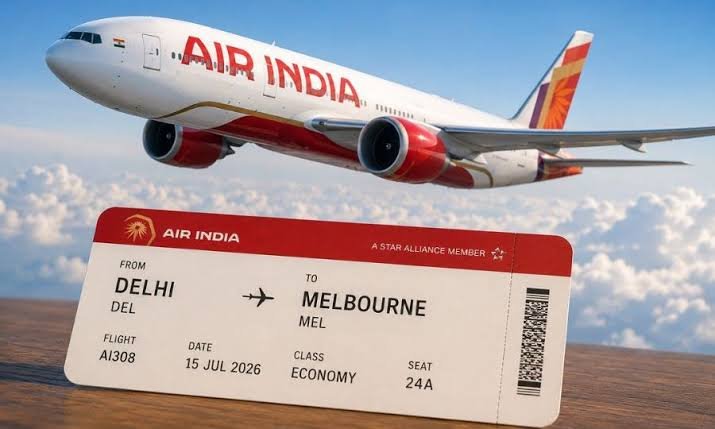
Air India has made a notable stride in upgrading its international long-haul flights through the introduction of the updated Boeing 777-300ER airplane on its Delhi-Melbourne route beginning July 1, 2026. This is a significant milestone in improving customer experience and part of the broader strategy of upgrading its fleet and raising service levels on the international routes.
Through the use of the new Boeing 777-300ER airplane, Air India has phased out the old Boeing 787-8 Dreamliner airplane on the route. Air India will not only be increasing its capacity but will also greatly improve passenger comfort and premium services through the adoption of the new plane.
Another significant enhancement includes the availability of First Class for the Delhi-Melbourne route that did not have First Class earlier. This change comes from the new emphasis of Air India on premium classes, with the aim to provide comfortable flights to its premium travelers. This aircraft has been designed in three classes: First Class, Business Class, and Economy Class.
In particular, the Boeing 777-300ER used on the mentioned route consists of eight First Class suites, 40 Business Class seats that can be converted into a fully flat bed, and around 280 Economy Class seats. It should be noted that the new plane has more business class seats than the Boeing 787-8, which was used earlier.
Along with the introduction of improved seats, the aircraft also brings along with it some improved onboard amenities that are aimed at providing the passengers better comfort during their flights. These amenities include an enhanced look of the cabins, improved upholstery, entertainment systems, and even Wi-Fi onboard.
The utilization of the improved aircraft falls under the transformation plans of Air India. The company has been transforming itself through improvement of its aircraft fleet, service quality, and network ever since its privatization. Since then, it has been spending lots of money not only refurbishing existing aircraft but also buying new ones to be able to compete with other international airlines.
Operational considerations include the advantages of an increased capacity and greater efficiency that come with changing to the 777-300ER. As a bigger airplane, it enables Air India to transport more people and cargo, making the route more profitable. In addition, the increased cargo capacity makes the plane ideal for the India-Australia route where the demand for flights and cargo has been increasing.
An additional point to consider about the upgrade is the timing of it. This is a good time to launch a more premium service as the demand for international air travel has been recovering significantly, especially on routes linking big cities around the world.
In terms of future plans, Air India has also revealed that it intends to operate flights at a higher frequency on the Delhi-Melbourne route. Commencing by later 2026, daily flights will be made available. Such a move will not only benefit passengers but also boost trade between India and Australia.
The decision by the airline to invest in modernizing its fleet of long-haul flights is part of an overall strategy that intends to make Air India a world-class global airline. The improvements being done include refurbishing the cabin, improving service delivery, and enhancing digital capabilities, which have seen gradual change in the image of the airline.
Further, the implementation of First Class is also anticipated to draw in high-end passengers who have chosen other airlines owing to their high-end services. Through the improvement of the product, Air India is not only raising the level of customer satisfaction, but also creating additional revenue sources.
In summary, the use of the improved Boeing 777-300ER on the route from Delhi to Melbourne can be considered a major step in the evolution process of Air India. As the aviation industry keeps developing, such improvements will become an essential tool for success in competition.