
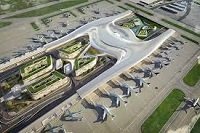
Adani Airports has announced a groundbreaking infrastructure plan that seeks to revolutionize India’s aviation sector by developing integrated airport cities in five different states. It is an important milestone in the process of transforming airports into multifunctional urban cities.
During the first phase of operations, it is estimated that the organization will make investments totaling more than ₹20,000 crore in the development of airport-enabled urban ecosystems spanning over 655 acres. These urban ecosystems will be developed around six prominent airports in the cities of Mumbai, Navi Mumbai, Ahmedabad, Lucknow, Jaipur, and Guwahati.
The basic concept of the initiative is the development of “airport cities” which are called aerotropolis in another name. It means constructing modern and autonomous urban communities based on the airports where different commercial and entertainment facilities are included in one connected system. It is supposed to improve the customer service and generate additional income sources.
A substantial amount of investment would go towards the development of the Mumbai Metropolitan Region, which includes the Mumbai and Navi Mumbai airports. Given that an almost 440-acre land would be developed here, it can certainly become a major aviation-led business hub in India.
The concept of airport cities is derived from the example of global successes like the airports in Singapore, Dubai, and Amsterdam. In these cities, the airports act as important economic drivers through their contribution towards tourism, business, and investments. With the help of this concept, Adani Airports hopes to achieve success in India.
Such an integrated development is likely to feature luxurious hotels, shopping centers, business parks, and entertainment facilities. Such projects will facilitate a walkable district which connects aviation with urban life, and hence serves the dual purpose of convenience for passengers, as well as attracts businesses around the airports.
Apart from being an initiative in infrastructure development, there would be significant gains that could be attained through it economically. Improved connectivity and commercial transactions are likely to result in the creation of jobs and development of the region. For example, cities such as Ahmedabad and Lucknow would gain from this investment.
This development will also be consistent with the fast-paced growth of the aviation industry in India owing to increasing passenger traffic and connectivity. Given that Adani Airports is one of the largest private airport operators in the country, it will definitely benefit from this growth in the aviation infrastructure industry.
– ₹20,000 crore investment in Phase 1.
– 22 million sq. ft. of development across Mumbai, Navi Mumbai, Ahmedabad, Lucknow, Jaipur, and Guwahati.
– Land bank: 655 acres, with 440 acres in Mumbai/Navi Mumbai alone.
– Nearly 70% of investment concentrated in MMR, India’s leading aviation and commercial hub.
Furthermore, the concept of the airport city ensures that the company can diversify the revenue stream from sources other than aeronautic through the generation of non-aeronautic income like retailing, real estate and hotel. This is in response to the growing phenomenon in the modern world where airports have become integrated destinations combining both business and leisure.
Moreover, through the airport city concept, diversification is possible for other revenue sources that are not related to aircraft movement. For example, revenue can be generated from retail outlets, real estate, and hospitality. It is a global trend where airports are being turned into commercial centers.
In conclusion, the establishment of integrated airport cities in five states is a visionary step towards the future of infrastructure and urbanization in India. Through the blend of aviation and real estate along with commercial activities, Adani Airports looks to establish world-class environments.
These developments will not only help in shaping new roles for airports in India, but they are also likely to define a whole new dimension for airports by converting them into bustling urban centers.

